
Desserts
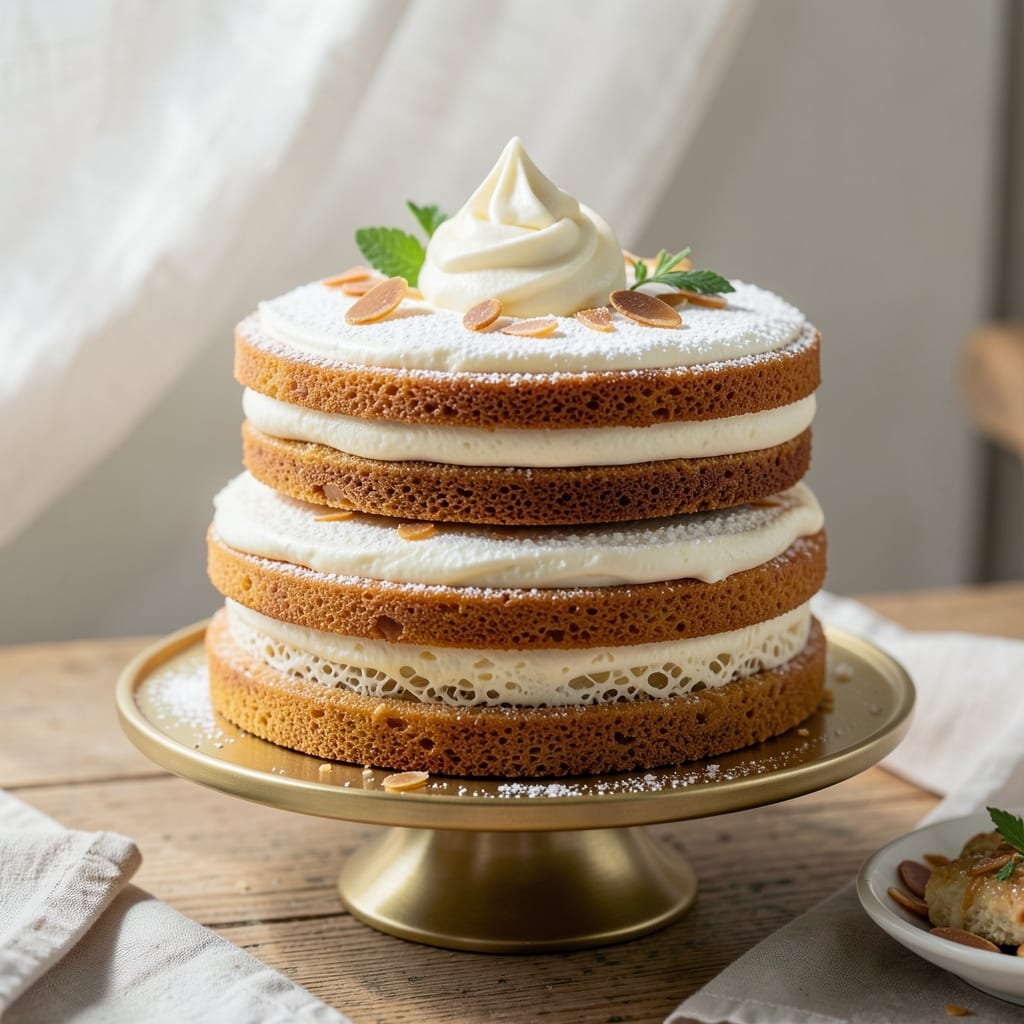
This almond macaroon cake delivers layers of creamy almond flavor with a delicate crunch that’s impossible to resist. 💛 The secret lies in perfectly folded egg whites and finely ground almonds, creating a texture that’s light yet substantial—ideal for special occasions or when you want to impress without fuss.
What sets this recipe apart is the balance of crispy macaroon layers and velvety almond cream filling, all baked to golden perfection. The process is straightforward but requires attention to detail—whipping egg whites to stiff peaks and gently folding in almond flour ensures the cake rises beautifully without becoming dense.
By the time you slice into this cake, you’ll find a harmonious blend of textures: tender crumb, crisp edges, and a rich almond cream that ties everything together. It’s elegant enough for celebrations but simple enough for a weekend treat, with optional decorations like toasted almonds or a dusting of powdered sugar.
The result is a dessert that tastes like a bakery masterpiece but comes together in your own kitchen. Ready to bake? Let’s get started with the ingredients and techniques that make this cake unforgettable.
Ingredients for almond macaroon cake
Egg whites, almond flour, and sugar create this elegant dessert with crisp layers and creamy filling.
| Ingredient | Amount | Notes |
|---|---|---|
| Superfine Almond Flour 🌰 | 3 cups | Finely ground for smooth texture |
| Large Egg Whites 🥚 | 8 whole | Room temperature for stiff peaks |
| Granulated Sugar 🍚 | 2 cups | Superfine preferred for smoothness |
| Unsalted Butter 🧈 | 1 cup | Cold, cubed for almond cream |
| Powdered Sugar 🍚 | 1 ½ cups | For almond cream filling |
| Vanilla Extract 🌿 | 1 tbsp | Pure, high-quality preferred |
| Almond Extract 🌰 | ½ tbsp | Enhances almond flavor |
| Salt 🧂 | ¼ tsp | Fine sea salt preferred |
| Toasted Sliced Almonds 🌰 | ½ cup | For garnish and texture |
| Powdered Sugar 🍚 | ¼ cup | For final dusting |
| Heavy Whipping Cream 🥛 | ½ cup | Optional for cream layer |
| Lemon Zest 🍋 | 1 tsp | Brightens almond flavor |
The almond flour is non-negotiable here—Bob's Red Mill or King Arthur brands work best for that ultra-fine texture. If you can't find superfine sugar, pulse regular granulated sugar in a food processor for a few seconds. Egg whites need to be at room temperature (pop them out of the fridge 30 minutes ahead), and your bowl should be spotless—even a trace of fat keeps them from whipping properly. For the almond extract, Goya or McCormick are solid choices, but if you're feeling fancy, a tiny splash of amaretto adds depth without alcohol flavor.
No almond flour? Finely ground blanched almonds (pulse in a food processor) work in a pinch, but texture will be slightly grainier. Substitute vanilla extract with seeds from a vanilla bean if you're feeling indulgent. The heavy cream in the filling can be swapped for Greek yogurt for a lighter version. For the toasted almonds, spread sliced almonds on a baking sheet and toast at 350°F for 8-10 minutes until golden—don't walk away, or they'll burn. The lemon zest can be skipped if you're not a fan, but trust me, it makes the almond flavor sing.
Assemble the cake layers immediately after baking while still warm—this helps the filling set properly. Store between layers of parchment paper in an airtight container for up to 5 days. For longer storage, freeze the fully assembled cake (without powdered sugar dusting) for up to 3 months. Let it thaw at room temperature before serving. The powdered sugar dusting is optional but adds that bakery-fresh touch—use a fine-mesh sieve for an even coat. If you make this ahead, bring it to room temperature before slicing for cleaner cuts.
Why You'll Love This Recipe
- No-Fuss Mixing: I swear by this recipe because it’s three ingredients, one bowl—just fold the egg whites into the almond flour and sugar until it clumps. No sifting, no creaming, no stress. The butter comes in later to bind it all, and honestly? That’s my kind of baking.
- Buttery Almond Magic: That crispy exterior with a tender, almost fudgy center? It’s the powdered sugar and melted butter working together like a dream team. The almond flour gives it a nutty richness, but the sugar keeps it from tasting dry—more like a cross between a macaroon and a shortbread cookie.
- Showstopper for Any Gathering: Between us, this cake looks fancy enough for a brunch spread but takes less time than ordering pastries. Slice it into squares, dust with more powdered sugar, and suddenly you’re the hero of book club or a last-minute potluck. (Yes, even on a Tuesday night.)
- Leftovers That Don’t Suffer: Unlike most cakes, this one actually improves the next day—if there’s any left, which there won’t be. The texture stays perfect for days, and it’s the kind of dessert that disappears faster than my willpower when I’m baking. Plus, it’s budget-friendly: almond flour is pricey, but a little goes a long way.
Step-by-step instructions for almond macaroon cake
Here's how to build this dreamy triple-layered cake with perfect crunch and creamy fillings.
👨🍳 Step 1: Whip Egg Whites to Stiff Peaks
In a spotlessly clean bowl, beat the 8 whole large egg whites with the 0.25 tsp salt using a stand mixer fitted with the whisk attachment. Start on low speed and gradually increase to high. You're aiming for stiff peaks—when you lift the whisk, the meringue should hold its shape and leave a slight trail.
This step is non-negotiable for structure. I like to add the sugar gradually: first 1 cup of the granulated sugar while mixing, then the remaining 1 cup once you reach soft peaks. Add the 1 tbsp vanilla extract and 0.5 tbsp almond extract at this stage too. The meringue should be glossy and hold its shape when you turn the bowl upside down.
👨🍳 Step 2: Fold in Almond Flour Gently
Using a spatula, gently fold the 3 cups superfine almond flour into the meringue in three additions. After each addition, fold just until combined—don't overmix or you'll deflate those precious air pockets. The batter should be thick but still pourable, like wet sand.
Here's the thing—don't worry if it looks like too much flour. The almond flour is finely ground and will blend smoothly. If the batter seems too stiff, add 1 tablespoon of water at a time until it reaches a consistency where it holds its shape when dropped from a spoon but still flows gently.
🍳 Step 3: Bake the Macaroon Layers
Preheat your oven to 350°F and line three 8-inch round cake pans with parchment paper. Divide the batter evenly among the pans, spreading each layer to the edges for even baking. Bake for 12-15 minutes until the edges are golden brown and the centers spring back when gently pressed.
I press down gently on the center of each layer during the first minute of baking—this prevents them from doming and ensures even contact with the pan. Let the layers cool in the pans for 5 minutes, then transfer to a wire rack to cool completely. The layers should be firm but still slightly springy to the touch.
🥘 Step 4: Prepare the Almond Cream Filling
In a medium bowl, beat the 1 cup cold cubed unsalted butter with the 1.5 cups powdered sugar, 1 tbsp vanilla extract, and 1 tsp lemon zest using a hand mixer until smooth and fluffy. In a separate bowl, whip the 0.5 cup heavy whipping cream to stiff peaks, then gently fold it into the butter mixture.
This is where the magic happens—the creamy almond filling that makes this cake extraordinary. The lemon zest brightens the almond flavor, while the cold butter creates that signature macaroon texture. Spread about ½ cup of this filling between each layer, pressing gently to create a clean edge. Save any remaining filling for the top layer.
⏰ Step 5: Assemble and Chill
Place the first layer in your serving dish, then spread the filling evenly. Add the second layer, more filling, and finally the third layer. For the top layer, spread the remaining filling and press the 0.5 cup toasted sliced almonds into the top, covering it completely. Dust with the 0.25 cup powdered sugar and chill in the refrigerator for at least 4 hours (overnight is best).
This chilling time is crucial—it lets the flavors meld and the cake set properly. The almonds will toast beautifully against the creamy filling, and the powdered sugar dusting adds that final touch of elegance. Serve at room temperature for the perfect balance of crunch and creaminess in every bite.
Pro Tips For Making Almond Macaroon Cake
- WHISK EGGS TO STIFF PEAKS: I learned this the hard way—underwhipped egg whites mean a cake that collapses like a sad soufflé. Use a stand mixer with the whisk attachment (or a hand mixer) and whip those whites until they hold a sharp peak when you lift the beaters. No wobbly tops? Keep going. This is the thing that matters most for that light, airy texture.
- SIFT ALMOND FLOUR FIRST: Superfine almond flour loves to clump like a grumpy cat. Sift it directly into your mixing bowl before adding anything else—this prevents lumps and ensures even distribution. I skip this sometimes, and the cake turns out dense. Not a dealbreaker, but why risk it?
- BAKE UNTIL GOLDEN, NOT JUST SET: That cake might look "done" at 325°F, but resist the urge to pull it out early. Bake until the top is golden brown and the edges pull away cleanly from the pan—usually around 350°F for 25-30 minutes. I’ve pulled them too soon, and they end up dry and crumbly. Better to err on the side of patience.
- CHILL THE BATTER 30 MINUTES: Sounds weird, but it works: Let your macaroon batter rest in the fridge for 30 minutes before baking. This gives the almond flour time to absorb moisture, which prevents cracking and makes the cake more uniform. I was skeptical until I tried it—now I never skip it. Your future self will thank you.
Dietary considerations for almond macaroon cake
Gluten-Free Assurance
This almond macaroon cake is naturally gluten-free since it relies entirely on almond flour and egg whites—no wheat-based ingredients anywhere. The superfine almond flour (like Bob's Red Mill or King Arthur) ensures a smooth texture without the need for gluten substitutes. For extra peace of mind, double-check that your almond extract and vanilla extract are also gluten-free certified. 🌰
Nut-Free Adaptation
If you're avoiding nuts entirely, swap the almond flour for 1 cup (100g) of finely ground blanched coconut flour (not coconut flour—it's much finer). You'll need to add 1 extra egg white to compensate for the coconut's moisture absorption. Toasted coconut flakes can replace the almonds for garnish. The texture will be slightly denser but still delightful.
Dairy-Free Options
For a dairy-free version, replace the butter with 1 cup (225g) of cold dairy-free margarine (like Miyoko's) and use 1 cup (240ml) of coconut cream instead of heavy whipping cream. The filling will still achieve that signature fluffiness, though it may have a slight coconut undertone. A pinch of cream of tartar helps stabilize the coconut cream when whipping.
Egg-Free Substitution
To make this cake egg-free, replace the egg whites with 8 tbsp (120g) of aquafaba (chickpea brine) or 1 cup (240ml) of aquafaba + 1 tsp apple cider vinegar. Whip the aquafaba to stiff peaks using a stand mixer, then fold in the sugar and extracts as directed. The texture will be slightly less airy but still hold together beautifully. For extra stability, add 1 tbsp (7g) of powdered xanthan gum to the almond flour mixture.
Refined Sugar-Free
Swap the granulated sugar for 2 cups (300g) of monk fruit sweetener blended with 1 cup (200g) of erythritol (like Lakanto). The blend mimics sugar's texture while keeping carbs low. For powdered sugar, use 1.5 cups (180g) of powdered erythritol (like Swerve). Note that the cake may be slightly less crisp due to the lower moisture content of sugar substitutes, but the flavor remains rich and satisfying.
Nutrition facts
Frequently asked questions
Why does my almond macaroon cake turn out dense instead of light?
Overmixing the batter or underwhipping the egg whites are the most common culprits. Make sure your egg whites reach stiff peaks (they should hold their shape when the whisk is lifted) and fold in the almond flour gently in three additions. Also, ensure your almond flour is superfine—coarse almond flour can create a heavier texture. If the batter seems too thick, add 1 tablespoon of water at a time until it reaches a pourable consistency.
Can I make this cake in a single layer instead of triple?
For a single-layer version, use just 1 cup of almond flour and 3 egg whites (reduce all ingredients proportionally). Bake in an 8-inch round pan for 10-12 minutes at 350°F. The single layer will be denser but still delicious—great for small gatherings or when you want a simpler presentation. Top with extra almond cream and toasted almonds for a showstopping effect.
How do I store leftovers to keep them fresh?
Store your almond macaroon cake in an airtight container at room temperature for up to 3 days. For longer storage, wrap each layer individually in plastic wrap, then place the whole cake in a freezer bag. It’ll keep for up to 3 months in the freezer. Thaw overnight in the fridge before serving. The filling may soften slightly after freezing, but a quick chill in the fridge will restore its creaminess.
Can I add chocolate or citrus to this recipe?
Yes! For a chocolate twist, fold in ½ cup of chopped dark chocolate (60% or higher) when you add the almond flour. For citrus lovers, increase the lemon zest to 2 teaspoons or add 1 teaspoon of orange zest to the filling. Both additions pair beautifully with the almond flavor—just be sure to adjust the baking time by 1-2 minutes if adding chocolate, as it can make the layers slightly denser.
What’s the best way to slice this cake without it crumbling?
Let the cake sit at room temperature for 30 minutes before slicing to even out the temperature. Use a hot knife (dip in hot water and wipe dry between cuts) for cleaner slices. Cut straight down without twisting, and serve immediately if the cake has been chilled—this prevents the layers from separating. For extra stability, slice into 1-inch thick portions so the filling stays intact.